
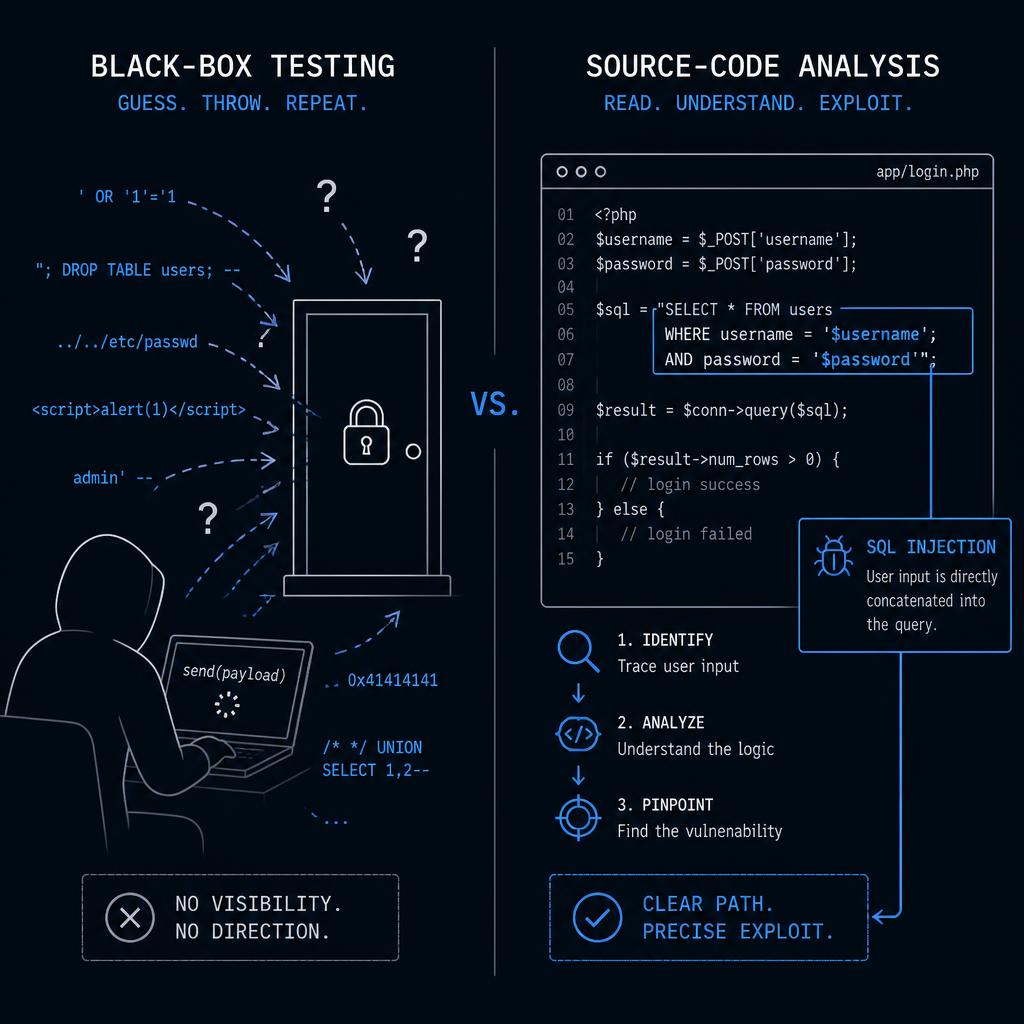
Most pentesters test web applications the same way – open Burp Suite, intercept requests, throw payloads, check responses. If something breaks, great. If not, move on. It works. But it has a ceiling.
That ceiling is the difference between finding what a scanner would find and finding what nobody else did.
The Black-Box Trap
Black-box testing means you see the application exactly as a user does. You have no idea what’s running underneath. So you test everything – every parameter, every endpoint, every header — hoping something reacts. It’s systematic but it’s also blind. You’re essentially knocking on every door without knowing which ones lead somewhere interesting.
The problem isn’t the methodology. The problem is you’re guessing.
You inject ' into a field and wait to see if the app crashes. You try {{7*7}} in a search bar hoping for SSTI. You send {"$gt":""} in a JSON body fishing for NoSQL injection. These aren’t bad tests – they’re just tests without context. You don’t know why that field might be vulnerable. You’re running a checklist.
What Changes When You Know the Backend
When you understand how a Flask application handles request data, you stop guessing and start knowing.
You know that request.args pulls from the URL query string, request.form from POST bodies, and request.json from JSON payloads – and that developers sometimes mix these up in ways that create injection points. You know that when a developer uses raw sqlite3 queries instead of SQLAlchemy ORM, there’s a SQLi surface worth investigating. You know that Jinja2 templates rendering user input directly means SSTI is a real possibility, not just a checkbox to tick.
This changes how you test completely.
Instead of blindly fuzzing every parameter, you look at how the application behaves and make educated inferences about how it was built. A JSON API with inconsistent error messages tells you something about the underlying ORM. A JWT with a long, seemingly random signature tells you something different than one with a short, clean one. An admin panel that returns 403 instead of 404 tells you the route exists and authorization is happening client-side or in middleware — which means it’s worth probing differently.
You stop going in blind. You go in with a model of what the code probably looks like, and you test against that model.
You Understand Why Things Work and Why They Don’t
This is the part nobody talks about enough.
When you’re black-box testing and a payload works, you write it in your report and move on. When it doesn’t work, you try the next one. You rarely stop to ask why.
But when you understand the backend, a failed payload tells you something. If ' OR 1=1-- doesn’t work but ' OR '1'='1 does, that tells you about the query structure. If SSTI works in one template but not another, that tells you about how the developer is passing variables. If a JWT alg:none attack fails, that tells you the library they’re using is probably validating the algorithm header — which means you should look for a weak secret instead.
Failed tests become information. Every response, every error message, every behavioral difference is a clue about the code underneath.
This is also why your remediations get sharper. When you find a SQL injection in a Flask app and you understand the developer used raw cursor.execute() instead of parameterized queries, you don’t just write “sanitize user input” in your report. You write the exact fix — parameterized queries with SQLAlchemy, or at minimum cursor.execute("SELECT * FROM users WHERE username = ?", (username,)). That’s the difference between a finding a developer dismisses and one they actually fix.
What This Series Covers
This is not a Python development course. You will not become a backend developer by the end of it. That’s not the point. But you need some basic knowledge of Python programming, as I will not teach that.
The point is that you will understand exactly how Flask routes handle user input, how Django REST Framework serializers create mass assignment vulnerabilities, how JWTs are implemented and where developers get them wrong, and how MongoDB queries behave differently from SQL in ways that create entirely different injection surfaces.
Each post in this series follows the same loop:
Understand how developers build it → see the vulnerable version → attack it → fix it
You will read real vulnerable code. You will understand line by line why it is vulnerable. You will exploit it. And you will see exactly what the fix looks like and why it works.
By the end, when you’re sitting in front of a Python web application on an engagement, you won’t be running a checklist. You’ll be reading the application’s behavior like a language — and it will tell you where to look.
The Stack
This series covers two frameworks:
Flask – minimal, widely used for internal tools and smaller APIs. Everything is explicit, which means mistakes are explicit too. Best framework to learn the fundamentals of web vulnerabilities in Python.
Django + Django REST Framework – the enterprise choice. Opinionated and structured, but that structure creates its own class of vulnerabilities — mass assignment, misconfigured permissions, raw query escapes.
My Thoughts
If you’ve been pentesting web apps and feel like you’re going through the motions — checking boxes, running the same tools, writing the same findings — this series is for you.
The goal isn’t to make you a developer. It’s to make you the kind of tester who finds what everyone else missed.